
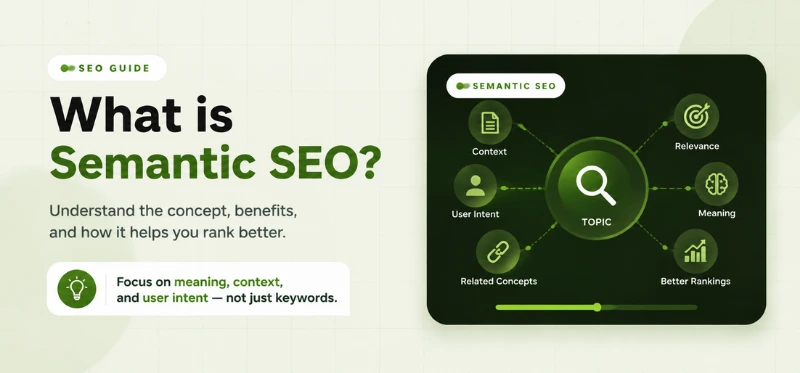
Semantic SEO is the practice of building authority across an entire topic rather than optimising individual pages for individual keywords. Instead of writing one page about local SEO and hoping it ranks, semantic SEO maps every subtopic, question, and related concept your audience searches for, then covers them all in a structured, interconnected way. The result is that search engines treat your site as a trusted authority on the subject, not just a page that mentions the right words.
Why keyword SEO is no longer enough
Traditional SEO focused on finding a keyword, putting it in a title, writing a page, and building links. That approach worked when Google matched keywords to pages. It works less well now because Google has shifted from keyword matching to entity and concept understanding.
Google’s Knowledge Graph and its natural language processing systems understand what topics mean, how they relate to each other, and which sites demonstrate real expertise on a subject. A site that covers one keyword in isolation sends weak signals. A site that covers an entire topic comprehensively sends a strong signal of expertise and authority.
Semantic SEO is the response to this shift. It is about being the most complete, most trustworthy source on a subject, not just the page with the most keyword mentions.
The core concepts of semantic SEO
Entities
An entity is any concept, person, place, or thing that can be distinctly identified. SEO is an entity. Google Business Profile is an entity. Karachi is an entity. When you write content, you are creating relationships between entities. Semantic SEO structures those relationships so search engines can map your expertise accurately.
Topical authority
Topical authority is the degree to which a website is trusted as a source on a specific subject. A site that covers every aspect of SEO — what it is, how it works, the different types, the tools, the process, the results — has stronger topical authority than a site that covers only one or two of those aspects. Google rewards topical authority with broader rankings across more related searches.
Topical map
A topical map is a structured plan of every topic and subtopic you need to cover to build authority in your subject. It starts with a central entity, then branches into every related concept, question, and attribute your audience searches for. Building a topical map before you create content is what separates semantic SEO from random blogging.
Contextual relevance
Contextual relevance is about how your pages relate to each other. A page about local SEO on a site that also covers technical SEO, semantic SEO, and ecommerce SEO has stronger contextual relevance than the same page on a site about fashion. Internal links between related pages signal those relationships to search engines.
How semantic SEO works in practice
Step 1 — Define your central entity
Every semantic SEO strategy starts with one central entity — the primary subject your site exists to cover. For seoagency.pk, the central entity is SEO. Every page on the site exists to expand, support, or reinforce authority around that entity.
Step 2 — Build the topical map
Map every topic your audience searches for in relation to your central entity. This includes definitional content (what is SEO), process content (how does SEO work), comparison content (SEO vs paid ads), and service-specific content (local SEO, technical SEO, ecommerce SEO). Each topic becomes a page or a cluster of pages.
Step 3 — Publish in the right order
The order of publication matters. Core pages — the pages directly tied to your central entity and your services — should be published first. Supporting content that builds topical coverage comes after. Publishing a blog post about semantic SEO before you have a semantic SEO service page is backwards.
Step 4 — Connect everything with internal links
Every page in your topical map should link to related pages. A blog post about how long SEO takes should link to the free audit page. A guide to local SEO should link to the local SEO service page. These internal links pass authority and signal the semantic relationships between your content.
Step 5 — Write answer-first content
Every page should answer the primary question in the first paragraph. Search engines and AI tools extract answers from the beginning of content. If the answer is buried in the fourth paragraph after a lengthy introduction, you lose the extraction opportunity. Lead with the answer, then expand on it.
Semantic SEO and AI search
Semantic SEO is directly connected to AI search visibility. When ChatGPT, Gemini, or Perplexity generates an answer about SEO services in Karachi, it pulls from sources that have demonstrated topical authority on the subject. Thin, keyword-only content does not get cited. Thorough, well-structured, entity-rich content does.
The same principles that make semantic SEO work for Google make it work for AI engines. Covering topics completely, writing in clear declarative sentences, and structuring content so each section is self-contained and extractable are what get you cited in AI-generated answers.
Semantic SEO vs traditional SEO
Traditional SEO: Find a keyword. Write a page. Build links to that page. Repeat for the next keyword.
Semantic SEO: Define the central entity. Map the entire topic. Build the core pages. Add supporting content. Connect everything. Let authority compound across the whole subject.
The difference in results: traditional SEO produces rankings for individual keywords that are vulnerable to algorithm updates and competitor pages. Semantic SEO produces rankings across entire topic clusters that are much harder to displace because they are backed by genuine topical authority.
How long does semantic SEO take?
Semantic SEO takes longer to build than traditional keyword SEO because it requires more content and more structured thinking. The first meaningful results typically appear within 4 to 6 months. The compounding effect — where new pages rank faster because existing pages have already built authority — begins around month 6 and accelerates from there. See our guide on how long SEO takes for a full timeline breakdown.
Frequently Asked Questions
Q: Is semantic SEO the same as content marketing?
A: They overlap but they are not the same. Content marketing is about producing content to attract and engage an audience. Semantic SEO is specifically about structuring that content around entities and topical maps so search engines can understand and rank it. Good semantic SEO requires good content, but good content without semantic structure does not always rank.
Q: Do I need a topical map before I start writing content?
A: Yes. Writing content without a topical map is like building a house without a plan. You end up with pages that do not connect to each other, topics that are covered twice, and gaps that competitors fill. The topical map is what makes the difference between a content library and a topical authority.
Q: Does semantic SEO work for small businesses in Karachi?
A: Yes, and it works especially well because most Karachi competitors are still doing keyword-only SEO. A small business that builds even partial topical authority on its subject will outrank larger competitors who have more pages but less structure. The playing field in Pakistani search is not yet fully optimised semantically.
Q: How does internal linking relate to semantic SEO?
A: Internal linking is how you signal the relationships between your entities to search engines. A page about local SEO that links to a page about Google Business Profile optimisation tells Google those two topics are related and that your site understands both. Without internal links, each page is an isolated signal. With them, your site becomes a connected entity network.
Q: Can I do semantic SEO on an existing website?
A: Yes. Start by auditing what you already have, map the gaps, and build the missing content. Existing pages can be updated to be more entity-rich and internally linked. It takes longer than starting from scratch but the existing domain authority speeds up the results.
The bottom line
Semantic SEO is how modern rankings are built. Keyword SEO gets you a position for one search. Semantic SEO gets you positions for hundreds of related searches and holds them through algorithm updates because they are built on genuine topical authority rather than on gaming a single keyword.
If you want to know whether your current content strategy is built for semantic authority or just keyword coverage, a free SEO audit will tell you exactly where the gaps are.

Ali Zulfiqar
Founder, SEO Specialist